




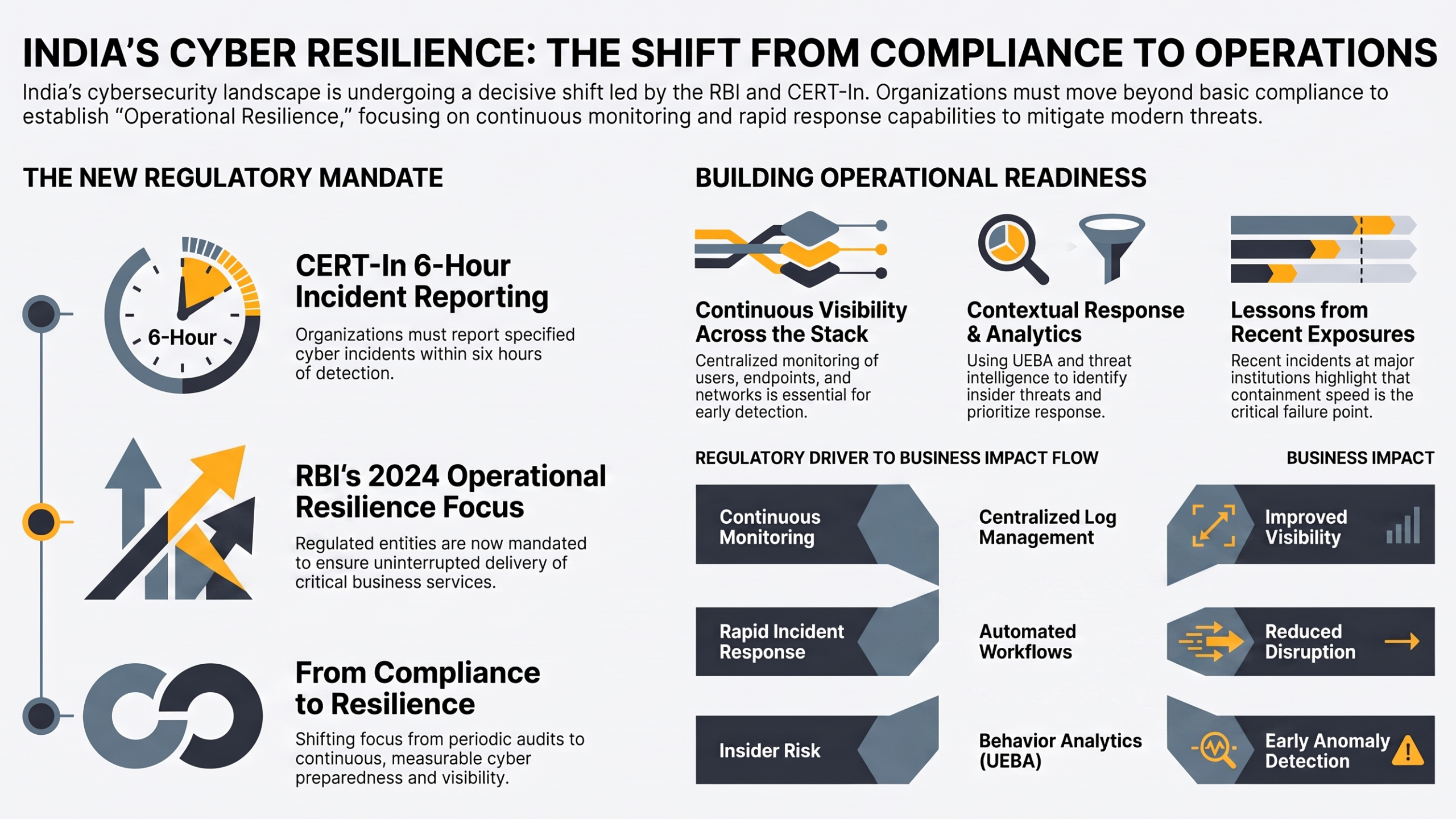
| Regulatory Expectation | What It Means for CISOs |
| CERT-In: Report specified cyber incidents within 6 hours | Incident response processes must be rapid, repeatable and well documented. |
| RBI: Operational resilience | Security operations should support uninterrupted delivery of critical business services. |
| Continuous Monitoring | Centralized visibility across users, endpoints, applications and networks is essential. |
| Threat Intelligence | Contextual threat data improves detection accuracy and response prioritization. |
| Behavior Analytics (UEBA) | Insider threats and anomalous activities can be identified earlier. |
This article is intended for CISOs, CIOs, SOC leaders, risk and compliance professionals and executives responsible for cyber resilience.
India’s cyber regulatory landscape is entering a decisive phase as RBI and CERT-In reshape how organizations approach cyber resilience, operational readiness, and security governance. RBI and CERT-In no longer focusses solely on compliance – they are driving a shift toward operational resilience, continuous monitoring and measurable cyber preparedness. For CISOs, this represents a strategic change in designing, measuring and continuously improving security operations.
RBI and CERT-In define the cybersecurity outcomes organizations should achieve. Operational excellence determines whether those outcomes are achieved. Thereupon, Prohori from FSN Tech Solutions helps bridge this gap through centralized monitoring, UEBA, threat intelligence, automated response and compliance-ready reporting.
According to the Reserve Bank of India [1]‘s Guidance Note on Operational Risk Management and Operational Resilience (2024), regulated entities are expected to strengthen cyber governance, operational resilience, third-party risk management, continuous monitoring, and incident response capabilities. Complementing this, CERT-In [2]‘s Directions under Section 70B of the Information Technology Act require organizations to report specified cyber incidents within six hours, maintain relevant logs and synchronize system clocks to support investigation and digital forensics. Undoubtedly, these regulatory developments signal a broader shift from compliance-driven cybersecurity toward resilience-driven security operations capable of detecting, responding to and recovering from cyber threats.
Compliance establishes the minimum standard but resilient organizations require continuous visibility, contextual analytics, coordinated response and proactive threat detection. Mature security operations reduce business risk rather than simply satisfying audit requirements.
Recent cybersecurity incidents across India’s banking, healthcare and public sectors reinforce a consistent lesson: Organizations rarely fail because security controls are absent – they struggle due to lack of timely and quickly detection, investigation and containment of threats.
Bank of Baroda Data Exposure (2026)
A reported data exposure involving Bank of Baroda highlighted how a compromised employee email account could potentially expose sensitive customer information. Although the bank confirmed that its core banking systems remained secure, the incident emphasized the importance of strong access controls, continuous monitoring and effective incident response.
DPDP Takeaway: Security safeguards and timely breach management are essential to protecting personal data.
Alleged DRDO Data Exposure (2026)
Reports claimed that data purportedly related to DRDO had appeared on the dark web, although officials stated that the authenticity of the claims was under verification. Thus, the incident demonstrates the need for continuous monitoring, rapid investigation and timely validation of potential data exposures.
DPDP Takeaway: Organizations should establish robust monitoring and incident assessment capabilities to respond effectively to suspected data breaches.
Kudankulam Nuclear Power Project Data Exposure (2026)
A reported data breach involving a contractor associated with the Kudankulam Nuclear Power Project exposed project-related files, while authorities confirmed that critical operational systems remained unaffected. The incident highlights the cybersecurity risks associated with third-party vendors handling sensitive information.
DPDP Takeaway: Strong third-party risk management and vendor oversight are critical for protecting personal data.
For security leaders, the takeaway is clear: regulatory compliance establishes expectations, but operational resilience is achieved through continuous visibility, contextual threat intelligence and rapid response capabilities that reduce the impact of cyber incidents before they escalate.
RBI and CERT-In define the destination, whereas security operations determine whether organizations reach it. Organizations that embed monitoring, analytics and response into day-to-day operations will be better prepared than those that treat cybersecurity as a periodic compliance activity.
Prohori unifies centralized log management, UEBA, MITRE ATT&CK-aligned detections, threat intelligence, automated response, analytics and compliance-focused reporting within a single SOC platform, enabling faster and risk-based decision-making.
| Regulatory Driver | Business Impact | Operational Capability | Prohori Capability |
| Continuous monitoring | Improved visibility | Enterprise monitoring | Centralized log management |
| Rapid incident response | Reduced disruption | Faster investigation | Automated response workflows |
| Insider risk | Early anomaly detection | Behavior analytics | UEBA |
| Threat preparedness | Improved detection | Threat intelligence | Integrated intelligence |
| Audit readiness | Regulatory confidence | Evidence & reporting | Compliance dashboards |
RBI strengthens cyber governance, operational resilience, monitoring and incident response.
Specified cyber incidents should be reported within six hours, supported by log retention and synchronized system clocks.
It enables earlier detection, faster response and stronger resilience.
It unifies monitoring, UEBA, threat intelligence, automation and compliance reporting.
Integrated security operations aligned with governance and resilience objectives.
As India’s digital economy continues to evolve, cyber resilience will become a competitive differentiator rather than merely a regulatory obligation. Furthermore, organizations that align governance, operational resilience, and intelligent security operations today will be better prepared to manage tomorrow’s cyber risks. Together, RBI’s operational resilience guidance and CERT-In’s incident reporting framework illustrate that cybersecurity is increasingly measured by an organization’s ability to maintain resilient operations rather than simply demonstrate regulatory compliance.
See how Prohori from FSN Tech Solutions helps organizations transform evolving regulatory expectations into intelligent, resilient, and measurable security operations.
References