




India’s Digital Personal Data Protection (DPDP) Act, 2023 [1] marks a significant step in strengthening data privacy and accountability. Compliance is no longer just a legal obligation – it is a business imperative that requires governance, cybersecurity and operational discipline. This practical checklist highlights the key actions Indian organizations should take to protect personal data, reduce compliance risks and build long-term customer trust.
As organizations accelerate digital transformation, they collect and process more personal data than ever before. Customers, regulators and business partners increasingly expect organizations to handle that data responsibly and securely.
The Digital Personal Data Protection (DPDP) Act, 2023 establishes a framework for the lawful processing of digital personal data in India. While the Act defines legal obligations, achieving compliance requires governance, security controls, continuous monitoring and accountability embedded into everyday operations.
For business leaders, the question is no longer ‘Do we comply?’ but rather ‘Can we consistently demonstrate that personal data is protected?’
DPDP compliance is not a one-time legal exercise. It is an ongoing operational capability built on governance, cybersecurity, accountability and continuous improvement.
Executive Perspective
Organizations that treat DPDP compliance as a governance capability – not merely a legal obligation – will be better positioned to earn customer trust, demonstrate accountability and adapt to future regulatory changes.
| Compliance Requirement | Why It Matters | Practical Action |
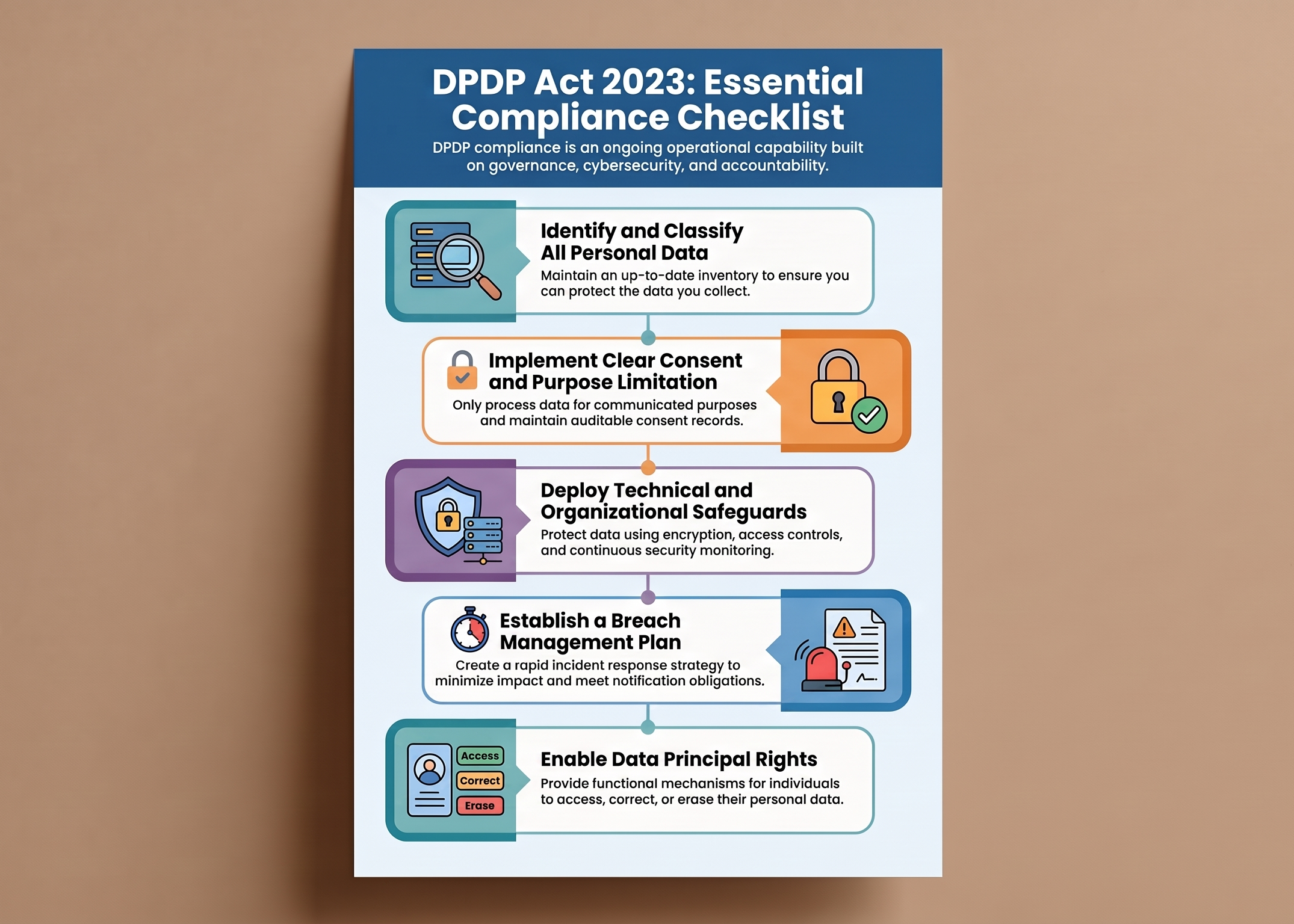
| Identify and Classify Personal Data (Data Inventory & Classification) | Organizations cannot protect data they cannot identify. | Maintain an up-to-date inventory of personal data. |
| Obtain Valid Consent (DPDP Act Consent Obligations) | Individuals should understand how data will be used. | Implement clear consent mechanisms and maintain auditable records. |
| Purpose Limitation (Specified Lawful Purpose) | Purpose limitation reduces risk. | Process data only for communicated purposes. |
| Purpose-Specific Data Collection (Limited Collection for the Stated Purpose) | Excessive collection increases risk. | Eliminate unnecessary data collection. |
| Appropriate Technical & Organisational Safeguards | Protect personal data. | Use encryption, access controls, VAPT and continuous monitoring. |
| Personal Data Breach Management & Notification | Rapid response minimizes impact. | Establish an incident response plan. |
| Data Retention & Erasure Obligations | Reduce unnecessary exposure. | Define retention schedules and secure disposal. |
| Enable Data Principal Rights (Access, Correction, Erasure, Grievance Redressal) | Support statutory rights. | Enable access, correction, erasure and grievance handling. |
| Data Processor Oversight & Accountability | Vendors introduce compliance risk. | Assess providers and review security. |
| Data Fiduciary Governance & Accountability | Accountability is essential. | Assign ownership and conduct reviews. |
FSN Tech Solutions supports organizations through DPDP readiness assessments, cybersecurity gap assessments, VAPT, security monitoring, governance & compliance consulting and security awareness training to build sustainable data protection capabilities.
The legal framework for processing digital personal data in India.
Organizations processing digital personal data within the Act’s scope.
Yes. Security safeguards and monitoring support DPDP compliance.
Operationalizing privacy across business functions.
Regularly as part of ongoing governance.
Organizations that build privacy into governance, technology and day-to-day operations will be better prepared not only to meet regulatory expectations but also to strengthen customer confidence and long-term business resilience.
Protecting personal data requires operational readiness. FSN Tech Solutions helps organizations assess compliance, strengthen cybersecurity controls and develop practical strategies for long-term DPDP compliance.
Reference