




Rapid expansion of India’s digital economy has widened the corporate risk surface. Cybercriminals have transitioned from amateur phishing emails to automated, industrial-scale social engineering campaigns. Powered by Generative AI, the next generation of cyber threats – predominantly deepfake videos, AI voice cloning, and hyper-personalized AI phishing – is redefining digital fraud.
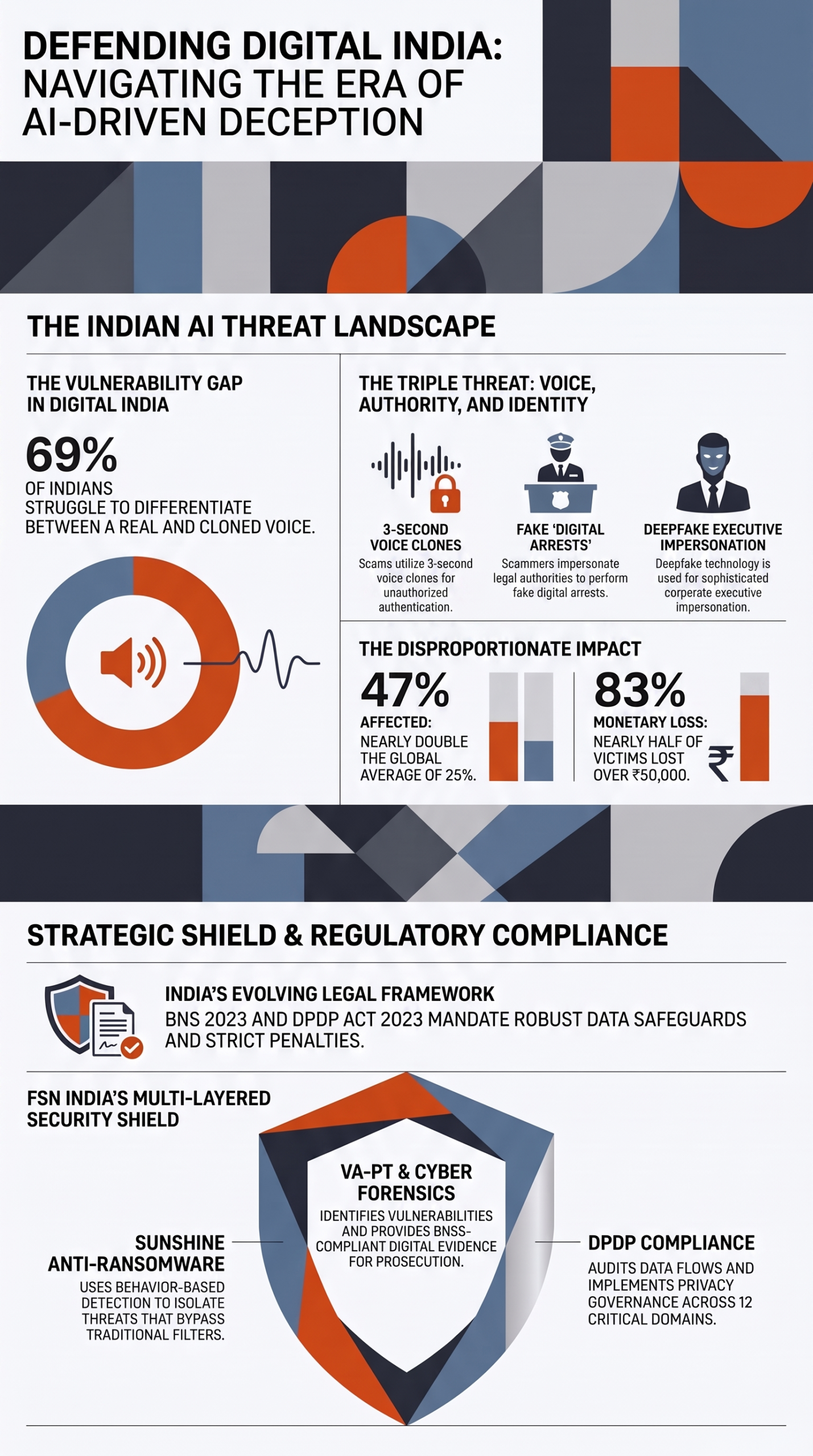
In India, AI-driven deception has become an organized, lucrative enterprise. A McAfee study reveals 47% of Indian adults have personally experienced or know a victim of an AI voice-cloning scam – nearly double the 25% global average. Additionally, 83% of Indian victims reported direct monetary losses, with nearly half losing over ₹50,000. Crucially, 69% of Indians admit struggling to distinguish real human voices from AI-generated clones.
The weaponization of trust leads the organizations and public figures to find identities hijacked in minutes. Enterprises must move past reactive checklists to build proactive, intelligence-driven defenses.
Organizations must understand how attacks are executed across three main vectors of AI voice cloning, “digital arrest” scams, and executive impersonation. This is to defend against emerging risks.
AI voice cloning is one of the most dangerous threats today. Using Generative AI, a malicious actor needs as little as three seconds of audio to create a near-perfect synthetic clone of a person’s voice.
Harvesting of audio snippets takes place from social media, YouTube, podcasts or direct calls. In Hyderabad Cybercrime Unit cases, scammers used cloned relative voices to fabricate urgent emergencies, coercing immediate financial transfers before families could verify claims. Bypassing of human intuition is easier as because the cloned voice matches pitch, tone and accent.
The “digital arrest” scam is one of India’s fastest-growing cyber frauds. Operating through transnational syndicates, scammers utilize high-definition deepfake video overlays on Skype, Zoom, or Microsoft Teams to impersonate law enforcement officials from the CBI, Narcotics Control Bureau (NCB), or state police departments.
Victims are contacted under pretexts linking their names to illegal narcotics, money laundering, or suspicious packages. Criminals construct virtual “police stations” or “courtrooms” using green-screen backdrops and forged legal documents. Under psychological pressure and threatened with immediate “digital arrest,” victims transfer massive sums into designated “safe-custody” or “mule” bank accounts.
In February 2026, the Supreme Court of India officially likened digital arrest scams to “digital dacoity.” Legally, no provision exists under the Bharatiya Nagarik Suraksha Sanhita (BNSS), 2023, or any Indian statute for law enforcement to conduct arrests over video calls. Yet, deepfake overlays mislead even tech-savvy individuals into paying extortion demands.
Corporate India faces brand-damaging deepfakes targeting business leaders, celebrities, and public figures to manipulate markets.
High-profile figures like Mukesh Ambani, Gautam Adani, and Narayana Murthy have had their likenesses and voices cloned to endorse fake investment schemes, while officials like Finance Minister Nirmala Sitharaman and External Affairs Minister S. Jaishankar have been featured in fraudulent financial deepfakes.
During elections, manipulated media peaked with the fake “Bitcoin” audio controversy involving Supriya Sule and Nana Patole, M. Karunanidhi’s synthetic voice clone, and manipulated campaign videos of Rahul Gandhi and actor Ranveer Singh.
Navigating India’s Legal and Regulatory Response
India’s legal frameworks are evolving to hold perpetrators accountable:
Securing an enterprise against deepfakes, voice cloning, and AI phishing requires an integrated defense architecture.
FSN Tech Solutions India, a trusted cybersecurity partner based in Kolkata, delivers the technical services and compliance governance required to mitigate these modern risks.
Cybercriminals gather intelligence via intrusions, leaks, or email compromises to harvest contact lists, org charts, and executive communications. FSN Tech’s VA-PT services patch vulnerabilities before attackers exploit them, securing perimeter, internal, and cloud data from AI phishing engines.
AI phishing attacks often deliver ransomware when deceived employees execute malicious attachments. FSN Tech’s Sunshine Anti-Ransomware solution acts as the last line of defense. Unlike traditional signature antiviruses failing against zero-day attacks, Sunshine uses behavior-based detection to instantly isolate infected endpoints upon encryption activity.
When security incidents occur – whether financial transfers triggered by voice clones or data breaches – rapid forensic investigation is critical. FSN Tech’s Cyber Forensic division provides end-to-end incident response, tracing digital trails, tracking cryptocurrency transactions, and documenting chain-of-custody protocols. FSN Tech delivers court-admissible digital evidence reports and updated BNSS-compliant certifications to ensure perpetrators can be legally prosecuted.
Because modern AI scams are fueled by stolen personal data, a mature privacy program is critical. FSN Tech specializes in helping organizations align with India’s DPDP Act, 2023. FSN Tech offers a DPDP Compliance Assessment across 12 compliance domains, helping enterprises audit data flows, secure registries, implement consent workflows, and deprive cybercriminals of profiling data.
Generative AI has ushered in a crisis of digital authenticity, executing “digital dacoity” and collapsing traditional trust. Enterprises can no longer operate on the assumption that seeing is believing or hearing is verifying.
To survive next-generation cyber threats, organizations must combine technical defenses with privacy governance. By partnering with FSN Tech Solutions India, enterprises implement proactive VAPT testing, deploy Sunshine behavioral endpoint protection, establish court-admissible cyber forensics, and ensure DPDP compliance – restoring digital trust.