




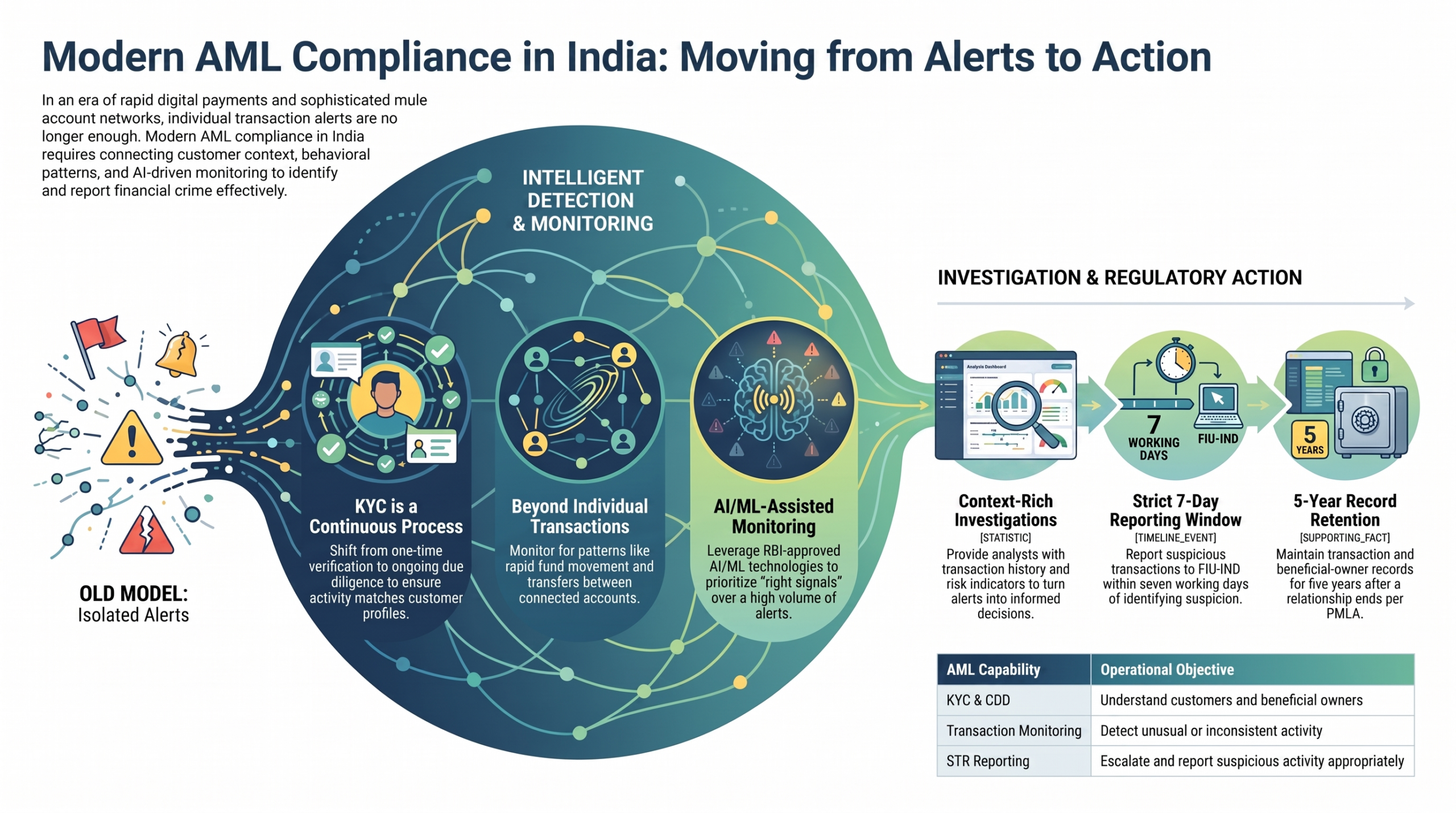
Financial crime is becoming increasingly difficult to detect as criminals exploit digital payments, mule accounts, layered transactions and interconnected financial ecosystems. In India, AML compliance associates with the Prevention of Money Laundering Act (PMLA), applicable rules, KYC framework of RBI and reporting obligations to the Financial Intelligence Unit–India (FIU-IND). Yet effective compliance requires more than collecting customer information or generating transaction alerts. Banks and fintech companies need to connect customer risk, transaction behaviour and emerging patterns to identify suspicious activity early and respond effectively.
A transaction can appear completely ordinary when viewed on its own. The same transaction may look very different when considered alongside a number of attributes. These attributes include customer’s history, counterparties, transaction velocity, geographic activity and expected source of funds. Indian banks and fintech companies are facing this challenge. Digital financial services have made transactions faster and more accessible, but they have also created an environment in which illicit funds can move rapidly across accounts, institutions and jurisdictions. Mule accounts, shell entities and layered transfers can make the original source of funds increasingly difficult to identify.
Recent enforcement activity illustrates the scale of the challenge. In 2026, Gujarat authorities reported uncovering cyber frauds worth ₹2,289 crore and identifying 913 mule accounts in a statewide operation. Separately, the Enforcement Directorate has investigated networks in which proceeds of cyber fraud were routed through multiple mule accounts, overseas fintech platforms and cryptocurrency channels. The implication for financial institutions is clear: AML effectiveness increasingly depends on understanding relationships and behaviour, not simply on individual transactions.
Effective AML is no longer about identifying more alerts. It is about identifying the right signals, understanding their context and turning them into timely action.
The first line of defence against financial crime is understanding the customer. KYC framework of RBI requires regulated entities to establish customer identification and due-diligence processes, including identifying and verifying customers and beneficial owners and understanding the purpose and intended nature of a business relationship where applicable. Customer information must remain relevant, risk classifications need periodic review and institutions must understand whether subsequent activity remains consistent with what they know about the customer, the customer’s business and the source of funds or wealth. This becomes particularly important in digital-first environments, where quick onboarding of a customer leads to commencement of transaction. A strong AML programme therefore needs to treat KYC as a continuing process rather than a one-time verification exercise.
Knowing the customer provides the context; transaction monitoring provides the ongoing view. KYC Direction of RBI requires regulated entities to undertake ongoing due diligence and monitor transactions for activity that is inconsistent with the customer’s profile or that appears unusual, complex, economically unjustified or without a legitimate purpose. The intensity of monitoring needs to align with customer risk. RBI specifically notes that regulated entities may consider appropriate AI and machine-learning technologies to support effective monitoring. This matters because suspicious behaviour does not always announce itself through a single large transaction. It may emerge through a pattern: unusually rapid movement of funds, multiple transfers between connected accounts, sudden changes in transaction behaviour, activity inconsistent with the customer’s profile or repeated transactions designed to avoid established thresholds. The challenge, therefore, is not simply generating alerts. It is determining which patterns genuinely warrant investigation while avoiding an overwhelming volume of low-value alerts for analysts to review.
Modern financial crime detection increasingly depends on connecting information that may otherwise remain fragmented. Consider a customer whose account receives funds from several seemingly unrelated sources before transferring the money through multiple accounts. Looking at each transaction independently may not reveal much. Connecting the customer, accounts, counterparties, transaction patterns and historical behaviour, however, can reveal a much stronger signal. This is where behavioural analytics, risk scoring, entity relationships and AI/ML-assisted monitoring can support investigators. The objective is not to replace human judgement, but to help analysts prioritise unusual activity and understand the context surrounding an alert. For fintech companies operating high-volume digital payment environments, this contextual capability can be particularly important. For banks managing large and often complex customer relationships, it can help security and compliance teams identify patterns that span products, accounts and channels.
An alert has limited value if investigators cannot determine reason behind its generation or what happened around it. Effective AML operations therefore require more than detection rules. Analysts need relevant customer information, transaction history, risk indicators and supporting evidence in a form that allows them to assess an alert efficiently. Risk-based prioritisation can help direct investigative attention towards cases with greater potential significance. This also supports a more defensible compliance process. During suspicious activity identification, institutions need appropriate escalation, investigation and documentation processes to ensure understanding and reconstruction of those decisions later. The goal is not to simply create more alerts but to create better-quality signals that lead to better-informed decisions.
Detection is only one part of AML compliance. Once a reporting entity is satisfied that a transaction is suspicious, the information must be reported to FIU-IND within the prescribed timeframe. FIU-IND states that suspicious transactions should be reported promptly and no later than seven working days from the date the Principal Officer is satisfied that the transaction is suspicious. The PMLA also requires reporting entities to maintain transaction records in a manner that enables individual transactions to be reconstructed and to retain relevant records for prescribed periods. Section 12 provides for five-year retention periods for transaction records and certain client and beneficial-owner records after the business relationship ends or the account is closed, subject to the statutory provisions. This makes investigation quality, documentation and record management integral to AML effectiveness. A suspicious activity monitoring programme should therefore connect detection with investigation, escalation, reporting and auditability rather than treating these as separate compliance functions.
Reputed banks and fintech companies face different operational realities, but the underlying requirement is increasingly similar. Banks may need to analyse activity across established customer relationships, multiple products and complex transaction environments. Fintech companies may have to manage rapid digital onboarding, high transaction volumes, API-driven ecosystems and relationships involving multiple technology or payment partners. In both environments, an effective AML programme needs to combine customer due diligence, risk assessment, ongoing monitoring, investigation and reporting into a connected operating model. Technology can strengthen that model, but technology alone is not the answer. Effective AML depends on the interaction between reliable data, appropriate detection logic, experienced investigators, clear governance and timely decision-making.
For banks and fintech companies, effective AML compliance increasingly depends on how well regulatory expectations are translated into everyday security and risk operations. Organisations need the ability to identify anomalous behaviour, investigate potential risks, strengthen their security posture and respond to emerging threats.
FSN Tech Solutions helps organisations strengthen their cybersecurity and risk-management capabilities through services including security assessments, Vulnerability Assessment and Penetration Testing (VAPT), security monitoring, threat intelligence, incident response, governance and compliance advisory. These capabilities can support financial institutions and fintech organisations as they strengthen the technology and operational controls surrounding their broader financial-crime, cybersecurity and data-protection programmes.
Financial crime detection is becoming a question of context, speed and connected intelligence. Strong AML programmes must move beyond onboarding and rule-based alerts to continuously understand customer behaviour, identify emerging patterns and provide investigators with the information needed to act. For banks and fintech companies, the objective should not be to generate the highest number of alerts. It should be to build an AML operating model capable of identifying meaningful signals, investigating them efficiently and supporting timely regulatory action. As India’s financial ecosystem becomes increasingly digital, organisations that combine regulatory discipline with stronger cybersecurity, analytics and operational capabilities will be better positioned to protect the integrity of their services and the trust of their customers.
As financial crime becomes more sophisticated, organisations need security capabilities that can keep pace with evolving threats. FSN Tech Solutions helps organisations strengthen cybersecurity, improve risk visibility and build more resilient security operations across an increasingly connected digital environment.
| AML Capability | Operational Objective |
| KYC & CDD | Understand customers and beneficial owners |
| Risk Assessment | Identify higher-risk customers, products and channels |
| Transaction Monitoring | Detect unusual or inconsistent activity |
| Behavioural Analysis | Identify patterns beyond individual transactions |
| Investigation & Case Management | Turn alerts into informed decisions |
| STR Reporting | Escalate and report suspicious activity appropriately |
| Record Management | Preserve evidence and support auditability |
Key requirements include customer due diligence, beneficial-owner identification, ongoing monitoring, risk assessment, record management and reporting suspicious transactions to FIU-IND, as applicable.
It helps organisations identify activity that may be inconsistent with a customer’s profile or indicate unusual, complex or economically unexplained behaviour.
FIU-IND states that suspicious transactions should be reported promptly and no later than seven working days after the Principal Officer is satisfied that the transaction is suspicious.
Yes. RBI’s KYC Direction states that regulated entities may consider appropriate AI and ML technologies to support effective ongoing transaction monitoring.