




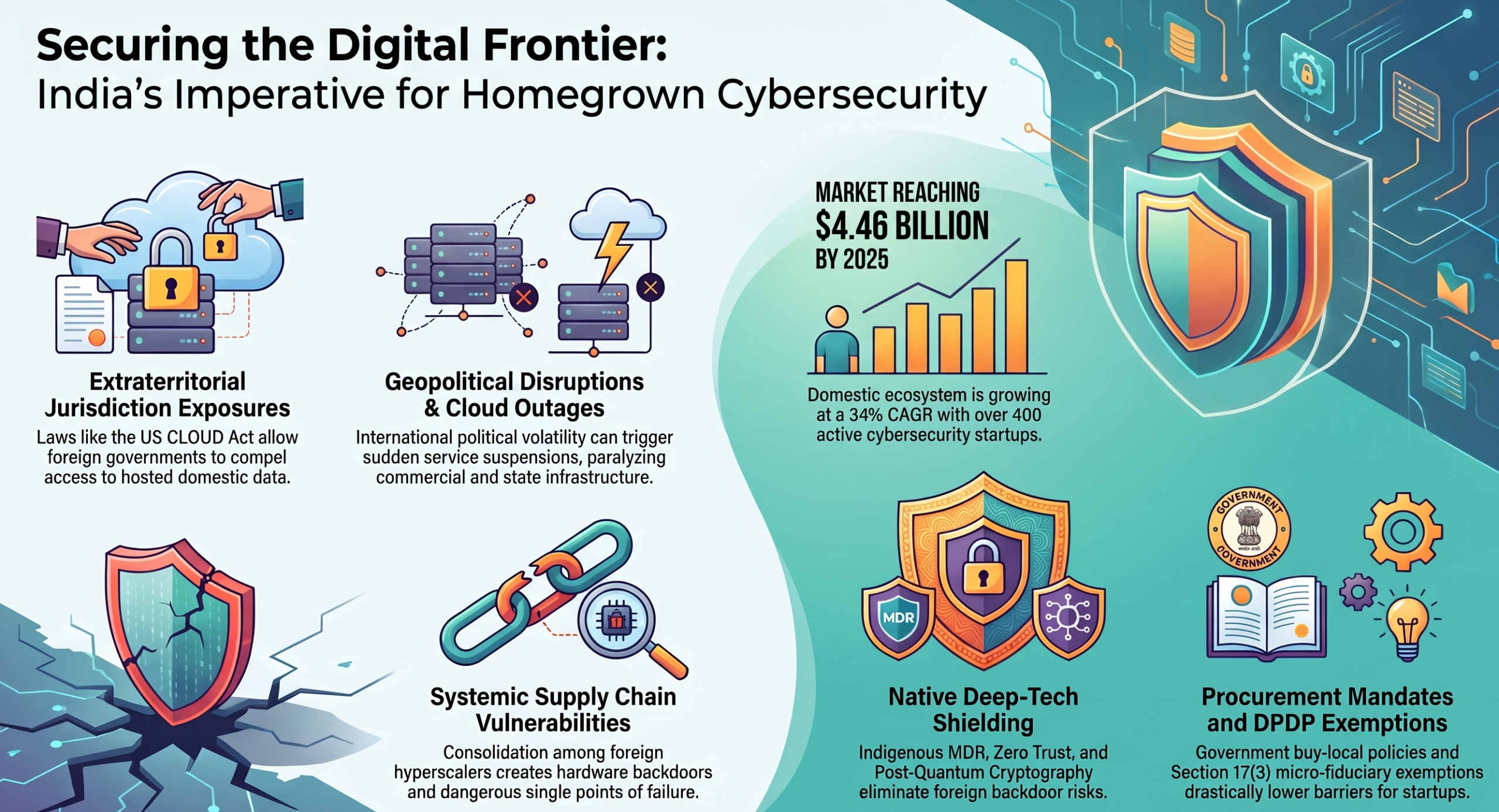
In modern geopolitics, technological capability is no longer merely an economic driver. Rather it is a foundational component of national power, military defense, and statecraft. As critical digital networks underpin government services, financial systems, and national defense. So, digital sovereignty has emerged as an indispensable pillar of national resilience. India cannot achieve true strategic autonomy while remaining reliant on foreign security products and foreign-controlled infrastructure. As they can expose critical digital assets to foreign legal jurisdictions, extraterritorial surveillance, and geopolitical friction. India needs to secure its physical and virtual borders, protect citizen privacy, and guarantee operational continuity. Thus, establishing a vibrant, homegrown cybersecurity startup imperative is a non-negotiable national mandate required for India to safeguard its strategic future.
India’s enterprise ecosystem and critical infrastructure rely heavily on foreign-owned public cloud stacks. This includes Amazon Web Services, Microsoft Azure, and Google Cloud. While these platforms have accelerated digital expansion, hosting mission-critical workloads on non-sovereign infrastructure introduces severe geopolitical and operational vulnerabilities. Indian entities do not own the underlying physical infrastructure. Thus, critical national assets remain exposed to foreign regulatory interventions, concentration risks, and international political volatility. Key exposure vectors stemming from foreign technology reliance include:
To mitigate foreign reliance, India’s domestic cybersecurity startup ecosystem is executing a rapid expansion. Empirically, DSCI baseline data shows that Indian cybersecurity product startups grew from 175 companies in 2018 to over 265 companies by 2021, generating $1.37 billion in product revenue with a dedicated workforce of 27,000. Synthesizing projections from the DSCI Report 3.0, the domestic cybersecurity market is on track to expand from $1.05 billion in 2020 to $4.46 billion by 2025 at a compound annual growth rate (CAGR) of 34%, driven by more than 400 active startups. Beyond market growth, domestic startups are pioneering deep-tech architectures that eliminate foreign backdoor risks and vendor lock-in. Natively built Managed Detection and Response (MDR) and Endpoint Detection and Response (EDR) platforms leverage local threat telemetry and AI/ML algorithms to stop zero-day exploits in real time. Zero Trust Network Architecture (ZTNA) frameworks replace implicit perimeter trust with granular identity verification, securing hybrid cloud environments and remote endpoints. Furthermore, native development of Post-Quantum Cryptography ensures high-value government and enterprise data remain protected against future quantum decryption threats.
| Ecosystem Metric / Technology | Strategic Value / Market Indicator |
| Market Expansion ($1.05B to $4.46B) | Projected growth at a 34% CAGR by 2025, anchored by $1.37B in product revenues achieved across 265+ startups in 2021. |
| Active Startup Density (400+ Startups) | Scaled ecosystem leveraging deep tech and a specialized talent pool to deliver sovereign, native security solutions. |
| AI/ML Threat Detection (MDR/EDR) | Provides continuous telemetry, automated threat hunting, and real-time prevention against zero-day and supply chain attacks. |
| Zero Trust Architecture (ZTNA) | Enforces strict identity verification and micro-segmentation across perimeter-less hybrid clouds, neutralizing lateral threat movement. |
| Post-Quantum Cryptography | Engineers next-generation encryption standards to shield critical defense and state communications from future quantum threats. |
Establishing digital autonomy requires an aligned regulatory framework that incentivizes indigenous technology adoption while reducing compliance burdens for early-stage innovators. The Indian government has instituted targeted policy levers to accelerate local cybersecurity integration across public and enterprise domains.
As India advances toward its centenary of independence in 2047, achieving digital sovereignty requires treating homegrown cybersecurity startups not merely as commercial vendors, but as core strategic assets of statecraft. Sustained cyber resilience depends on a robust tri-fold alliance: deliberate state procurement mandates, proactive corporate board governance – enforced through sovereign data mapping and tiered cloud architectures – and aggressive startup-led deep-tech R&D. By institutionalizing indigenous security technologies across critical infrastructure, India will ensure total control over its digital architecture, safeguard its economic vitality, and project sovereign power on the global stage. “True digital sovereignty requires an unshakeable ecosystem where native startup innovation safeguards critical infrastructure, securing India’s strategic autonomy and national power toward 2047 and beyond.”