





Supply-chain cyber-attacks have moved from isolated incidents to systemic risk for Indian manufacturing and IT services firms. As organizations accelerate digital transformation, they increasingly depend on third-party vendors, outsourced development partners, cloud providers, and interconnected production ecosystems. This interdependence has expanded the attack surface far beyond traditional enterprise boundaries.
Today, a breach at a trusted supplier can halt factory operations, expose sensitive client data, and trigger cascading failures across multiple organizations. Supply-chain cyber-attacks are no longer technical failures- they are strategic business risks affecting revenue continuity, regulatory compliance, and India’s global digital credibility.
India’s rapid growth as a global manufacturing base and IT services hub has intensified third-party dependency. Software vendors, managed service providers, system integrators, and cloud platforms now sit deep inside enterprise environments, often with privileged access.
At the same time, cybersecurity maturity across supplier tiers remains uneven. Tier-2 and Tier-3 vendors frequently lack robust monitoring, segmentation, and response capabilities. Attackers exploit these weaker links to gain indirect entry into larger enterprises, by passing hardened perimeter defenses. The cascading impact is increasingly evident. A single supplier compromise can affect multiple Indian firms and their international clients simultaneously, amplifying operational disruption and reputational damage.
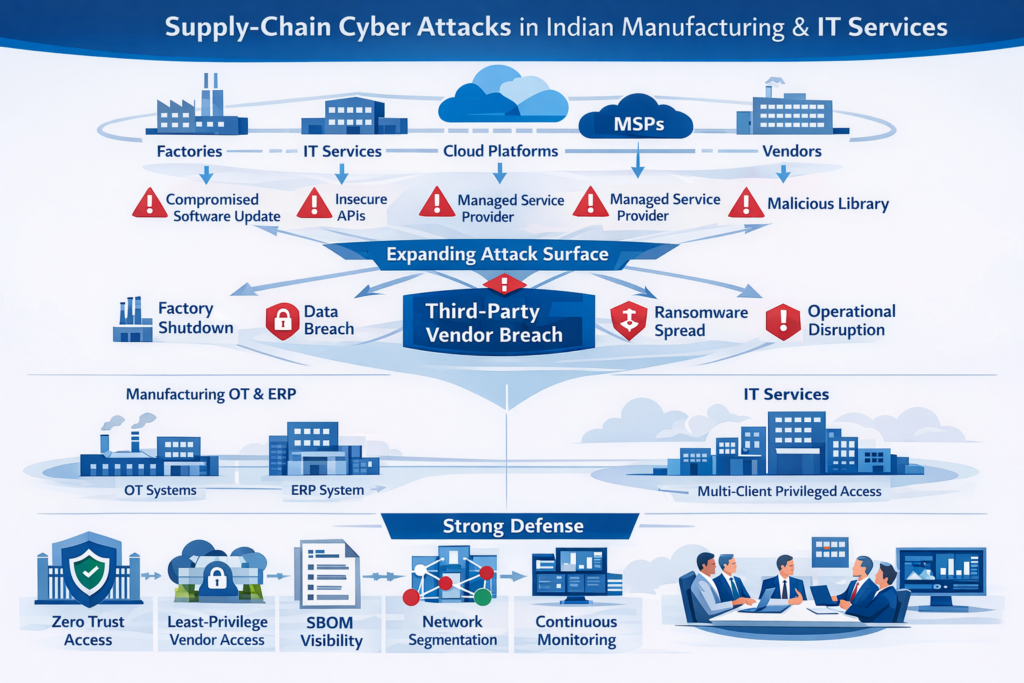
Attackers favor supply-chain vectors that deliver scale and stealth. Compromised software updates and malicious libraries provide immediate access across thousands of customer environments. Managed service providers are especially attractive targets due to their broad administrative privileges.
Excessive and persistent vendor access enables lateral movement after initial compromise. Insecure APIs and weak integrations further extend trusted pathways into enterprise systems, allowing attackers to operate under the cover of
legitimate access.
The consequences of supply-chain cyber-attacks extend far beyond the initial breach. Manufacturing firms face production shutdowns, logistics delays, and operational technology disruption. IT services providers risk exposure to client data, source code, and credentials across multiple customer environments.
Ransomware propagates rapidly through trusted connections, accelerating spread and increasing leverage. Regulatory and contractual fallouts follow, as supplier-originated breaches still trigger penalties, audits, and disputes. Over time, repeated incidents erode global client trust, directly impacting renewals and growth.
Manufacturing environments rely on tightly integrated OT, ERP, and supplier platforms that expand trust boundaries. IT services firms aggregate privileged access across numerous clients, creating high-impact compromise points.
From an attacker’s perspective, one successful supplier breach delivers maximum reach. Supply-chain access enables stealthy lateral movement that often remains invisible to traditional security monitoring.
Reducing supply-chain risk requires shifting from implicit trust to continuous verification.
Organizations must strengthen third-party risk management with security-driven onboarding, continuous risk scoring, and clear accountability. Software Bills of Materials improve visibility into third-party components and accelerate response
during active exploitation.
Zero Trust principles must apply to vendor access, always enforcing least privilege and strong authentication. Segmenting vendor and OT connectivity limits blast radius when compromises occur. Continuous monitoring of supplier activity
helps detect misuse of trusted access early.
Equally important is preparedness. Supplier-focused incident response exercises ensure coordination across security, procurement, legal, and executive leadership when real incidents unfold.
Supply-chain cyber risk cannot be delegated solely to technical teams. Boards and executive leadership must treat it as an enterprise risk with direct business impact.
Cybersecurity must be embedded into procurement decisions alongside cost and performance. Accountability must be shared across cybersecurity, procurement, legal, and business leaders. Continuous oversight through regular reviews and
simulations strengthen long-term resilience.
Supply-chain cyber-attacks have become a defining threat for Indian manufacturing and IT services firms operating within deeply interconnected ecosystems. Organizations that focus only on internal defenses remain exposed through their weakest suppliers. Enterprises that invest in vendor visibility, enforce accountability, and continuously test supply-chain resilience will be best positioned to protect operations, reputation, and global trust in an increasingly hostile cyber environment.